
Published 2026-09-24 · ASHTANGA YOGA
The value of repetition in Ashtanga
Some days practice flows. On others, the same sequence asks for more patience and attention. Returning to it lets us notice what has changed. In Ashtanga Yoga, repetition is not about reproducing an identical performance. It creates room to study breath, movement and our responses to difficulty.
The sequence as a reference
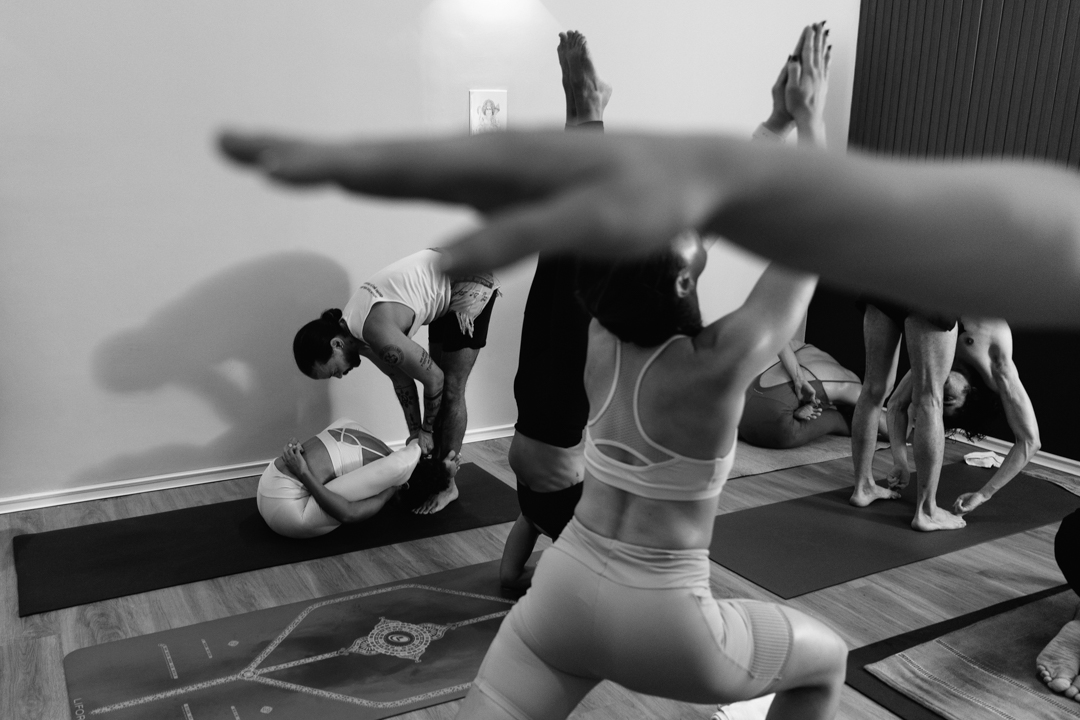
In Mysore style, each person works through the part of the sequence they know, at their own pace, while receiving individual guidance. The order provides a stable structure without requiring haste. A new movement is learned as the previous one becomes familiar and the relationship with the breath grows clearer.
That structure reveals change from one day to the next. An easy posture may expose tension; a difficult one may become more accessible. The point is not to collect shapes, but to develop attention to the process. Consistency matters more than any one session.
Three things to notice
Breath: does it accompany movement, or disappear when effort increases?
Pace: can you remain attentive between postures?
Response: when difficulty appears, do you feel haste, comparison or curiosity?
These questions do not require perfect answers. They make repetition an inquiry rather than a mechanical habit.
The sequence returns. What we learn from it may change every day.
Learning without skipping steps
A beginner need not know every series, memorise many names or reach a certain level of flexibility. The first steps are concrete: understand the class format, explore the breath and learn the opening movements with guidance.
Lucas recommends two private classes for anyone new to Ashtanga or uncertain about the method. Each lasts between one hour and one hour and fifteen minutes. Afterwards, student and teacher decide whether the online group is appropriate or more private classes would help. Joining the group is not automatic.
A possible path
Discuss your experience, questions and availability.
Learn the foundations in two individual classes.
Decide with Lucas whether to join a group or continue privately.
Inside a Mysore room
People in a Mysore room may be at different points in the sequence. The teacher attends to each practice within a shared space of study. The recording below shows Sharath Jois teaching in that context. It is a third-party video included to illustrate the room’s dynamic.
A recording does not replace individual guidance. To learn about the introduction and indicative private-class availability, visit Start here.